


Cordyceps Sinensis and Liver Health: What Modern Research Reveals About Its Anti-Fibrotic Potential

Updated: 6 hours ago
For centuries people have used Cordyceps sinensis, a fungus that is valued in Himalayan medicine. The fungus has a reputation, for healing and protecting the body. Cordyceps sinensis has been used to raise energy to support immunity and to improve health. Modern research shows that Cordyceps sinensis also protects the liver from long term damage. The fungus also stops liver fibrosis.
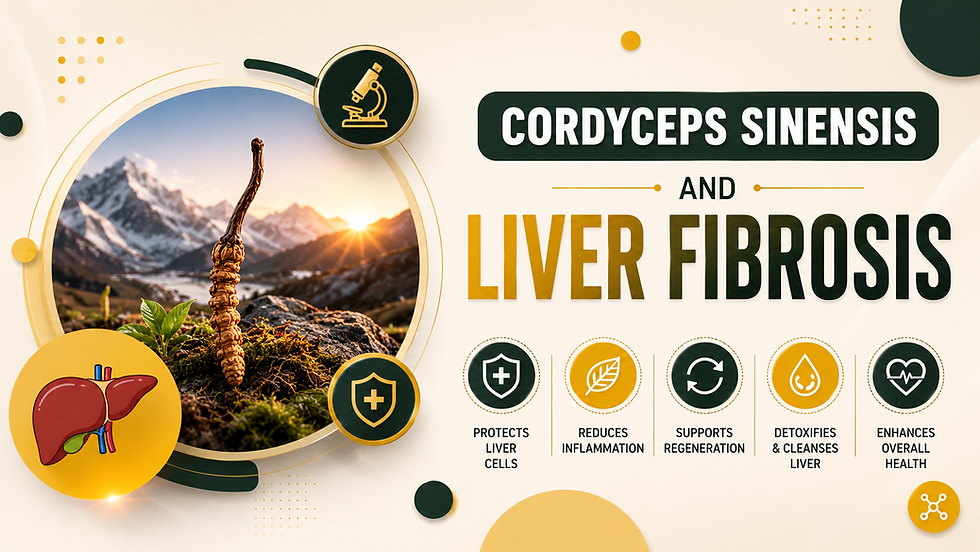
In a landmark study published in the World Journal of Gastroenterology, researchers investigated how Cordyceps sinensis (CS) affects the evolution of liver fibrosis, a condition caused by long-term liver injury that can progress to cirrhosis. The results were quite good, giving strong scientific evidence for a natural medicine that has been used for a long time.
Understanding Liver Fibrosis
When the liver is injured for a long time by factors like toxins, alcohol, viral infections, or metabolic abnormalities, it begins developing up scar tissue. Fibrosis is the name for the emergence of scar tissue. Fibrosis can turn into cirrhosis, which is a permanent medical condition where the natural structure of the liver breaks down and impairing its ability to function.
However, the fibrosis stage still holds a hopeful advantage: it is reversible. If treated in time, the progression to cirrhosis can be prevented.
Why Cordyceps Sinensis?

Cordyceps Sinensis has long been used as a tonic for the kidneys and liver in traditional Chinese medicine. Yu-Kan Liu and Wei Shen conducted a study to address this deficiency by meticulously examining the impact of CS on liver structure, function, and molecular activity in the context of chronic damage.
How the Study Was Conducted
Researchers utilized 66 male Wistar rats, categorizing them into three groups:
Normal Control Group: Healthy-rats
Model Control Group – Rats with long-term liver damage caused by carbon tetrachloride (CCl4) and ethanol
Cordyceps Group: Rats with liver damage that were given CS after 10 days of damage.
After 9 weeks, the researchers analyzed liver tissue, biochemical markers, and molecular activity in all of the groups.
Key Findings: Cordyceps Protects the Liver on Multiple Levels
1. Significant Reduction in Liver Damage
Liver enzymes ALT and AST are two of the most significant markers of liver cell damage. High levels imply that the liver is in trouble.
Rats treated with Cordyceps had levels of ALT and AST that were much lower than those in the injured model group, almost restored to normal values.
This strongly shows that CS helps protect and fix liver cells when they are hurt for a long time.
2. Cordyceps Slows Down Fibrosis Formation
Two serum markers—Hyaluronic Acid (HA) and Laminin (LN)—increase as fibrosis worsens. In the study:
The model group showed very high levels of both markers.
The Cordyceps-treated group had 40–50% lower levels.
This indicates that CS helps slow down the deposition of scar tissue, a critical step in preventing cirrhosis.
3. Less Collagen Production (Scar Tissue)
Fibrosis occurs when excessive proteins, such collagen I and III, grow up.
Researchers discovered that Cordyceps:
Very strongly stopped the synthesis of collagen I
Also decreased the formation of collagen III (almost statistically significant).
Less collagen formation means less scar tissue, which means a healthier liver structure.
4. Cordyceps regulates Key Molecules That Cause Fibrosis
Two major cell signaling proteins, or cytokines, are key players in liver scarring:
Transforming Growth Factor β1 (TGF-β1)
This is the main cause of fibrosis, responsible for:
Causing the body to make collagen.
Activating hepatic stellate cells (the cells that form scar tissue).
Preventing the enzymes that break down collagen.
Cordyceps strongly reduced both TGF-β1 protein and its mRNA, indicating its role in inhibiting fibrosis at the genetic level.
PDGF (Platelet-Derived Growth Factor)
Known as the most powerful promoter of stellate cell proliferation, PDGF levels were dramatically lower in CS-treated rats.
Together, these two reductions indicate that Cordyceps suppresses fibrosis at its very root: cell signaling and activation.
What Do These Results Mean?
This study shows that Cordyceps sinensis doesn't just offer minor protection; it actually stops the metabolic pathways that lead to fibrosis, including:
reducing inflammation
inhibiting fibrotic cytokines
preventing stellate cell activation
lowering collagen production
preserving overall liver structure
Under a microscope, the treated rats' liver tissue looked healthier, with fewer fibrotic septa and better-preserved lobules.
In simpler terms, Cordyceps helps the liver:
✔ Heal faster
✔ Scar less
✔ Function better
✔ Resist progression to cirrhosis
Why This Matters?
Chronic liver conditions, like hepatitis and injuries from drinking too much alcohol, are a global health problem. Researchers are looking into a lot of new medications, but only a few of them are safe and effective for long-term antifibrotic use.
But cordyceps:
is natural
is well-tolerated
has been used safely for centuries
shows major protective effects without reported side effects
This makes Cordyceps Sinensis a valuable complementary option for individuals looking to support liver health—especially in the early stages of chronic liver damage.
The Future of Cordyceps in Liver Therapy

The study finds that Cordyceps sinensis is a promising antifibrotic herb that should be studied more in modern medicine. It may someday play a big part in:
Preventing cirrhosis
Supporting recovery from chronic hepatitis
Improving overall liver function
As global interest in natural medicine grows, Cordyceps stands out as an herb that integrates ancient wisdom with modern scientific validation.
Final Thoughts
This potent fungus has historically been praised for its beneficial effects to vigor and longevity. Modern study confirms that its benefits significantly extend liver protection and regeneration.
While more human trials are needed, the evidence so far is compelling: Cordyceps sinensis holds immense potential as a natural protector against chronic liver injury and fibrosis.
If you are exploring natural ways to support liver health, Cordyceps may be one of the most scientifically promising herbs to consider.



Comments